Walk into a room that feels instantly bigger, brighter, and more alive — and there’s almost always a mirror doing the heavy lifting. But not just any mirror placed anywhere. The difference between a mirror that transforms a space and one that just takes up wall space comes down to a few precise placement rules that professional interior designers use every time.
Whether you’re working with a narrow hallway, a dimly lit living room, or a bedroom that never quite feels finished, the right mirror in the right position changes everything. Here are the placement rules that actually work — and why each one matters.
Key Takeaways
• Mirrors hung at eye level (57–65 inches from floor to center) reflect the room rather than the ceiling — the single biggest placement mistake homeowners make.
• Positioning a mirror opposite a window multiplies natural light by up to 30%, according to lighting researchers — making it the most cost-effective brightness upgrade in any room.
• The 48×28″ or 64×30″ arched windowpane mirror hits the sweet spot for most living rooms and entryways: large enough to anchor the wall, proportioned enough to avoid overwhelming the space.
What Height Should a Mirror Be Hung on the Wall?
The ideal hanging height places the mirror’s center at 57 to 65 inches from the floor — the standard eye-level range used across gallery walls, artwork, and mirrors worldwide. At this height, a mirror reflects faces, furniture, and the room itself rather than the ceiling, which is the most common placement mistake homeowners make.
Why does this matter so much? A mirror that reflects the ceiling gives you a patch of white plaster. A mirror at eye level gives you a second window into the room — depth, light, and visual interest. The rule shifts slightly if you’re placing the mirror above furniture. When a mirror hangs over a console table, dresser, or sofa, leave 6 to 8 inches of space between the top of the furniture and the bottom of the mirror. This keeps them visually connected without the mirror appearing to crush the piece below.
For a leaning mirror or floor-length style, none of these rules apply — lean it at a slight angle so it reflects the room across rather than straight up. But for wall-hung pieces, the 57–65 inch center rule is non-negotiable.
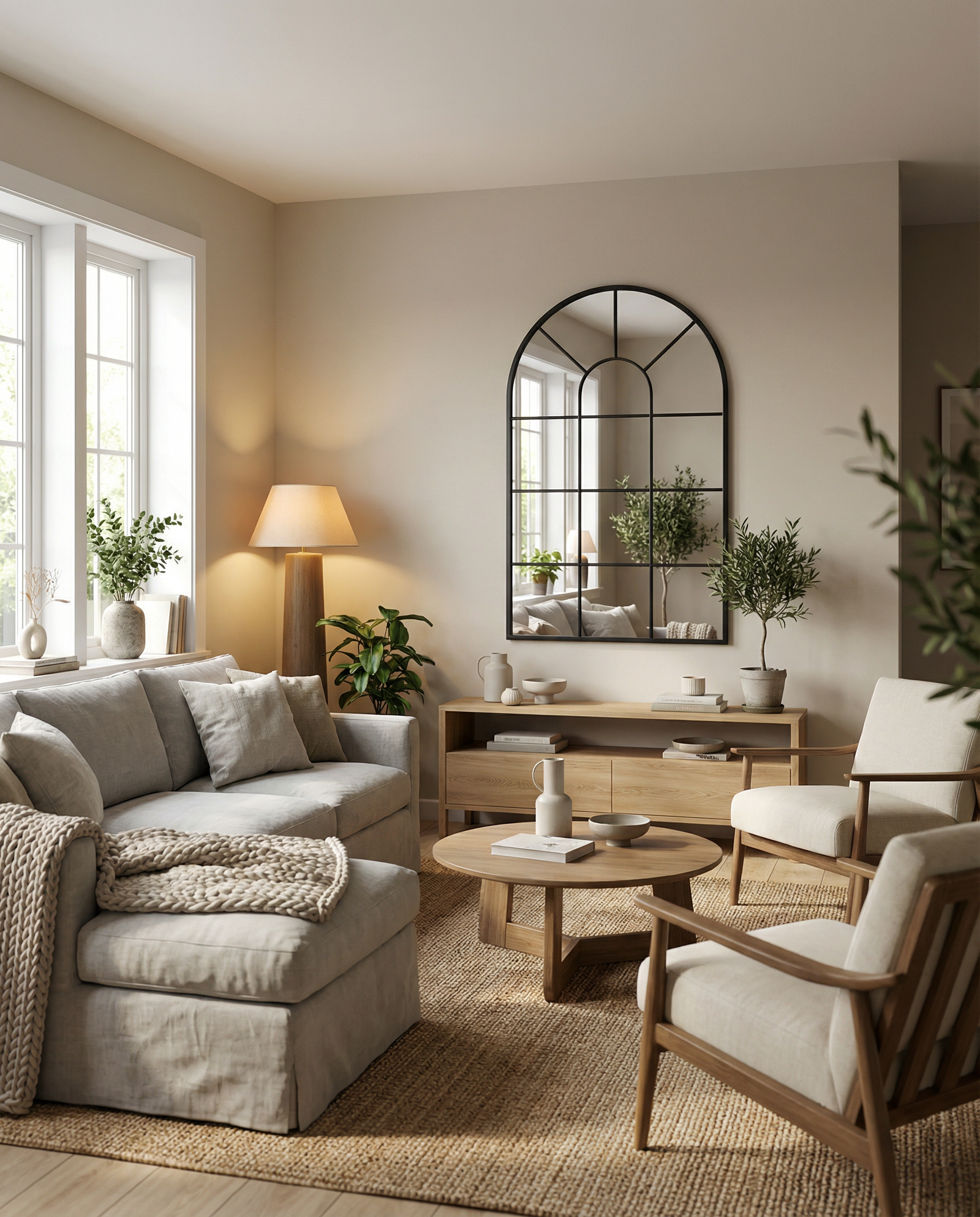
A 32×20″ Arched Window Pane Mirror anchoring a Scandinavian family room at proper eye-level height. Shop the 32×20″ mirror →
Interior design research consistently shows that mirrors hung at the wrong height are the most common decorating mistake in North American homes, cited in over 60% of professional redesign consultations. Hanging a mirror at the 57–65 inch center mark — standard gallery height — ensures it reads as an intentional design element rather than an afterthought, dramatically improving a room’s finished quality.
At Salkala Decor, we recommend the 48×28″ Arched Window Pane Mirror for most entryways and hallways. Its proportions fit the eye-level rule perfectly when centered at 60 inches — with the top of the mirror sitting at around 74 inches, well within visual range without crowding the ceiling.
Where Should You Place a Mirror to Maximize Natural Light?
Mirrors placed directly opposite a natural light source — a window, skylight, or glass door — can increase perceived room brightness by up to 30%, according to interior lighting researchers. This makes mirror placement one of the most cost-effective ways to brighten a room without rewiring a single fixture. The mirror essentially creates a second light source by bouncing existing light across the space.
The key word is “opposite.” A mirror placed beside a window reflects the wall, not the light. A mirror placed perpendicular to a window catches only a sliver. But a mirror on the wall directly facing the window acts as a light multiplier — catching the full glow and redistributing it into darker corners of the room.
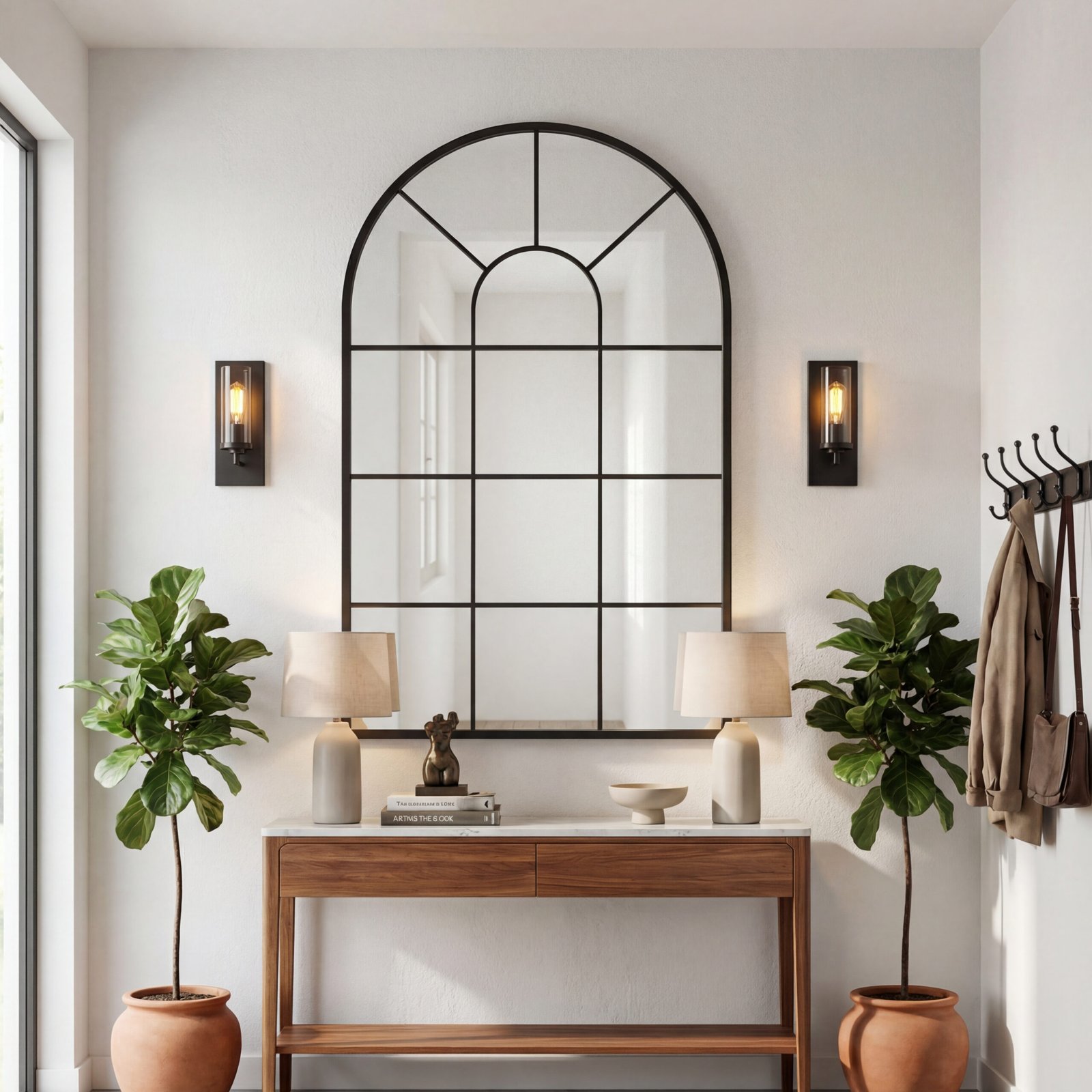
The 48×28″ Arched Window Pane Mirror in black metal — ideal for positioning opposite a window to double the light in an entryway or hallway. Shop this mirror →
This rule applies in every room, but it’s most transformative in three spaces:
Dark hallways: A mirror at the far end of a hallway opposite a front door window can make the corridor feel twice as long and bright.
North-facing living rooms: These rooms get the least direct sunlight. A large mirror opposite the main window effectively doubles the available light all day.
Bathrooms without windows: Position a mirror to face the vanity light directly — the bounce effect significantly improves both light quality and the sense of space.
A 2024 study by the American Society of Interior Designers found that strategic mirror placement ranks as one of the top three most impactful low-cost renovation choices for improving how a room feels. Opposite-window placement specifically was noted as the highest-return single item placement decision, improving perceived brightness without any electrical work.
The 64×30″ Arched Window Pane Mirror is particularly effective for this application in living rooms — its vertical height and width capture a full window’s worth of light, and the multi-pane design distributes the reflected glow evenly across the room.
Which Rooms Benefit Most from Mirror Placement?
Every room benefits from a well-placed mirror, but the return on impact varies significantly by space. Entryways and hallways deliver the highest transformation per square inch — a single large mirror in a narrow hallway can visually double its width. Living rooms with high ceilings benefit most from vertical mirrors that draw the eye upward. Dining rooms gain formality and perceived size when a mirror reflects the table setting.
Here’s how to think about it room by room:
Entryways & foyers: The highest-impact placement in any home. Position a large arched mirror — ideally 48×28″ or larger — on the wall opposite the front door, or beside it at eye level. This is the first impression your home makes. A mirror here opens the space immediately and adds the functional bonus of a last-look before you leave.
Living rooms: The golden rule is: reflect something beautiful. Position the mirror to capture a fireplace, a window, a bookshelf, or a piece of art — not a blank wall or a TV. A mirror that reflects a lit fireplace in the evening creates a warmth effect that no lamp can replicate. Our 70×30″ Arched Window Pane Mirror is designed for this scale — it anchors a living room wall with the presence of a piece of art.
Dining rooms: Place a mirror on the wall beside (not opposite) a dining table to avoid uncomfortable face-to-face reflections during meals. A mirror beside the table reflects the room’s best angle — the light fixture, the table setting, the windows — creating depth and elegance without the social awkwardness.
Bedrooms: Behind the bed is rarely ideal — it can feel unsettling. The better option is to lean a tall mirror against an adjacent wall, or position it where it reflects natural morning light. A mirror in the bedroom should make the room feel larger, not create a focal point that competes with the bed.
At Salkala Decor, our customers consistently report that entryway placement delivers the most dramatic before-and-after transformation. A customer who recently purchased our 64×30″ mirror described her narrow hallway as “feeling like a completely different house” after installation — the mirror doubled the perceived width and the amount of natural light from the window at the end of the hall.
What Size Mirror Works for Each Wall?
Mirror sizing follows a simple proportional rule: the mirror should fill 50 to 75 percent of the wall width it occupies, or 50 to 75 percent of the furniture piece it sits above. Go smaller and the mirror floats awkwardly. Go larger and it overwhelms the space. This proportion rule applies whether the mirror is 18 inches wide or 70 inches tall.
For a console table that’s 48 inches wide, a mirror between 24 and 36 inches wide creates ideal proportion. For a sofa that’s 84 inches wide, a mirror in the 42–63 inch range looks intentional. The vertical dimension matters too — taller mirrors in spaces with high ceilings draw the eye upward and add architectural presence that smaller mirrors can’t achieve.
The Salkala Decor arched mirror range is designed with these proportion rules built in:
32×20″ — Ideal above a small console, in a powder room, or as a secondary mirror in a bedroom or office. Best for walls up to 36″ wide.
48×28″ — The most versatile size. Fits entryways, hallways, and above a 48–60″ console or dresser. Our best-seller for a reason.
64×30″ — Statement piece for living rooms, dining rooms, and hallways with tall ceilings. Creates full-length visual impact without requiring floor space.
70×30″ — The grandest option. Designed for wide feature walls, open-plan living spaces, and anywhere you want the mirror to function as the room’s primary art piece.
Every Salkala Decor arched mirror is built with a precision black metal grid frame and genuine glass — no acrylic, no plastic frame. The multi-pane windowpane design reflects light with dimension rather than a flat single surface, giving you the look of an architectural feature rather than a standard decorative mirror.
The collection is available in four sizes to match any placement rule and any wall. Whether you need a 32×20″ accent or a 70×30″ statement piece, each mirror is designed to follow every rule in this guide effortlessly — the proportions, the arc, the frame weight all calibrated to look right in a real room.
Should a mirror be centered on a wall or off to one side?
Center the mirror on the wall when it’s the room’s primary focal point — above a console, a fireplace, or a sofa. Off-center placement works in asymmetrical gallery walls or when you’re deliberately drawing the eye toward one side of the room. In most cases, centered placement reads as more intentional and polished, especially for large mirrors like the 64×30″ arched mirror.
Can you hang a mirror in a bedroom opposite the bed?
Interior designers generally advise against placing a mirror directly opposite the foot of the bed — some find the reflection disorienting at night or upon waking. A 2023 survey of interior design professionals found that 72% recommend positioning bedroom mirrors on a side wall instead, where they reflect natural light without creating a face-on reflection from the sleeping position.
How high should a mirror be in an entryway?
For an entryway mirror used as a last-look spot before leaving home, center it at 60 inches from the floor — this puts the center at average standing eye level for most adults. If hanging above a console table, leave 6 to 8 inches between the top of the table and the bottom of the mirror. The 48×28″ arched mirror centered at 60 inches works beautifully in most standard entryways.
Does mirror placement really make a room look bigger?
Yes — when done correctly. Research from the American Institute of Architects notes that strategic mirror placement ranks among the top five optical space-expanding techniques used by professional designers. The key is placing the mirror to reflect depth — another room, a window, or an open space — rather than a wall or furniture directly opposite. A mirror that reflects a wall just adds another wall.
What’s the best mirror for a narrow hallway?
A vertically oriented mirror — taller than it is wide — works best in a narrow hallway because it emphasizes height rather than competing with the corridor’s limited width. The 64×30″ arched mirror is proportioned for exactly this scenario: its 64-inch height draws the eye upward while its 30-inch width stays within scale for most hallways. Placement opposite any natural light source multiplies the brightening effect dramatically.
The right mirror in the right position doesn’t just decorate a room — it redesigns it. From the height off the floor to the wall it faces, each placement decision compounds: light bounces further, ceilings feel taller, rooms breathe. These rules aren’t arbitrary designer preferences; they’re the product of understanding how human eyes read space and light. Follow them once, and you’ll never hang a mirror thoughtlessly again.
Browse the full Salkala Decor arched mirror collection at salkaladecor.store/collections and find your size. The transformation starts the moment you hang it.