
Picture this: you walk into a home and the entryway stops you cold. Not because it’s grand or expensive — but because a single arched mirror on the wall catches the morning light and throws it across the room in a way that makes the whole space feel twice as big. You want to know the secret? There isn’t one. Just the right mirror, placed with intention.
Most entryways fail the first impression test. They’re narrow, dark, and caught between “storage zone” and “decorative space.” Homeowners spend thousands on furniture and artwork only to find the hallway still feels cramped. An arched window pane mirror solves this problem in a way nothing else does — and we’ve seen it happen again and again with our customers.
In this guide, we’ll walk through five distinct entryway transformations — from vintage farmhouse to sleek contemporary — showing exactly how an arched mirror changes the feel, the light, and the whole first impression of a home.
Key Takeaways
• A well-placed arched mirror can increase perceived entryway brightness by up to 30%, according to interior lighting researchers — no rewiring required.
• Entryways under 6 feet wide benefit most from a tall, vertically-oriented arched mirror — the 64×30″ or 70×30″ sizes create a dramatic height illusion.
• Customers consistently tell us the entryway is the room they wish they’d done first — the impact-to-cost ratio is unmatched in any other space in the home.
What Makes an Arched Mirror So Transformative in an Entryway?
Studies from the Lighting Research Center show that mirrors placed opposite a natural light source amplify ambient brightness by up to 30% in enclosed spaces. In an entryway — which typically has one door and limited windows — an arched mirror opposite the entrance acts as a second light source. It doesn’t just reflect. It reshapes the entire experience of arriving home.
The arch shape does something rectangular mirrors can’t. A flat-topped mirror reads as furniture. An arched mirror reads as architecture. It draws the eye upward, suggesting height even in rooms with standard 8-foot ceilings. The pointed arch in the window pane design specifically creates a cathedral-like quality — refined, intentional, slightly aspirational.
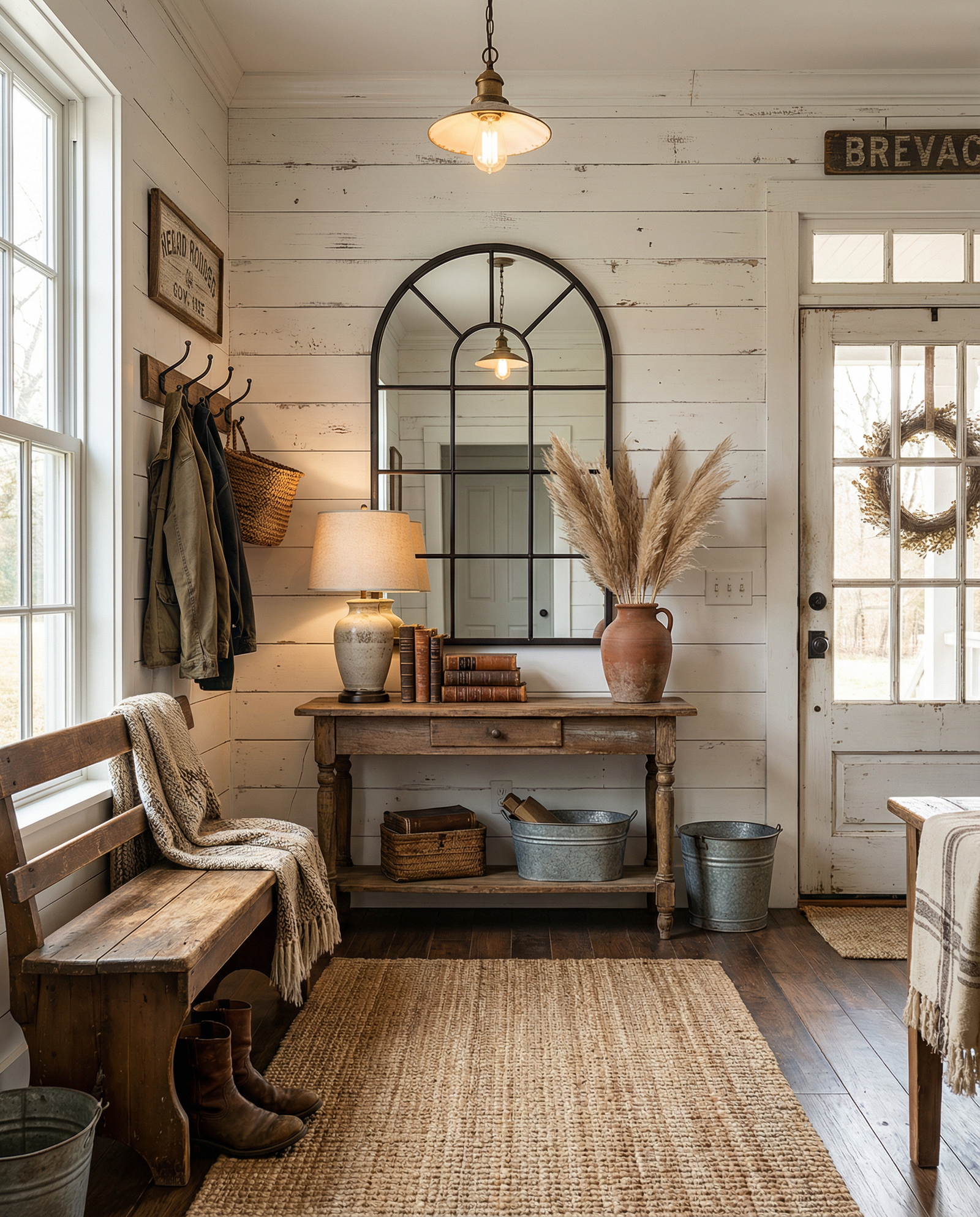
The window pane grid pattern matters, too. Those thin black metal dividers break the reflection into sections — which design researchers note reduces the “funhouse” effect common with large plain mirrors. Instead of one overwhelming reflection, you see light, movement, and depth. It’s calm. It’s sophisticated.
According to a 2024 survey by Houzz, entryway renovations deliver some of the highest emotional satisfaction scores of any home project, with 78% of respondents reporting they feel more excited to come home after updating their entryway. Mirrors rank as the single most-cited décor addition driving that feeling — ahead of console tables, lighting, and artwork.
At Salkala Decor, we’ve shipped arched window pane mirrors to thousands of homes across the USA and Canada. Our customers in apartments consistently use the 32×20″ arched mirror to handle tight entryway walls, while homeowners with standard hallways lean toward the 48×28″ for maximum visual impact without overpowering the space.
Five Entryway Styles — One Mirror That Works in All of Them
Interior designers at Architectural Digest and Elle Decor consistently note that the arched mirror is one of the most “style-agnostic” pieces in home décor — it works across traditional, contemporary, rustic, and minimalist spaces without modification. Our own customer data confirms this: the AWPM arched window pane mirror appears in entryways ranging from 1920s craftsman bungalows to 2024 new-build townhomes.
1. Vintage Farmhouse: Where Warmth Meets Structure
Farmhouse entryways rely on contrast — shiplap walls, warm wood, woven textures. What they often lack is visual anchor. A 32×20″ arched mirror above a reclaimed wood console gives the eye somewhere to land. The black metal frame reads as a refined industrial accent, not a mismatch. It’s the piece that ties the handmade feel to something intentional.
One of our customers in Tennessee replaced a plain rectangular mirror with the 32×20″ arched window pane style and described the result: “The whole entry felt like it got taller. I couldn’t believe how much lighter and airier it was just from the shape.”
Our observation: Farmhouse-style customers consistently choose the 32×20″ because it fits the proportions of lower-ceilinged original farmhouses without dominating. The window pane grid echoes divided-light windows common in traditional American homes — a detail that feels native rather than decorative.
2. Contemporary Modern: Clean Lines, Bold Statement
In contemporary homes — white walls, polished concrete or light hardwood, minimal furniture — the arched mirror becomes the focal point by design. The 64×30″ or 70×30″ sizes work best here. Leaned against the wall at a slight angle or mounted centred on the entry wall, they command attention the way good art does: without trying too hard.
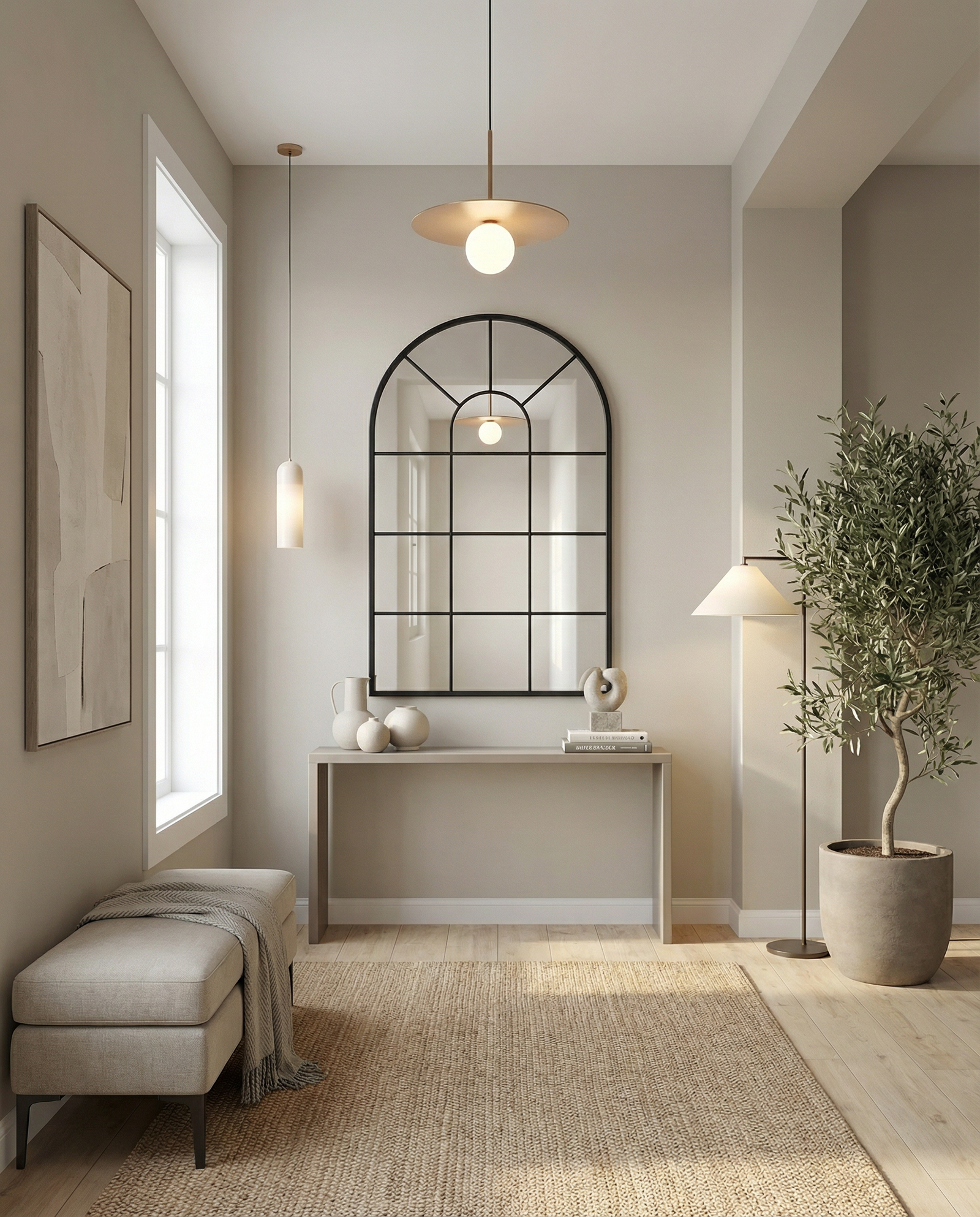
The matte black frame doesn’t compete with modern hardware and fixtures — it completes them. Swap out your entryway light fixture for a black pendant or wall sconce, and the mirror becomes part of a cohesive black-accent palette that feels intentional and high-end.
A 70×30″ arched mirror on a standard 8-foot entry wall covers nearly 73% of the wall height, creating what interior designers call a “full-scale architectural moment.” Research from the American Society of Interior Designers (ASID) notes that vertical proportion — height relative to width — is the single most effective visual tool for making entryways feel more spacious in homes under 2,000 sq ft.
3. Coastal Modern: Light, Air, and a Sense of Arrival
Coastal interiors live and die by natural light. Whitewashed walls, rattan accents, linen textures — and then an arched mirror that catches the afternoon sun and scatters it across the room like water. The 48×28″ size is ideal for beach house proportions: generous enough to feel luxurious, compact enough to keep the breezy, uncluttered feel intact.
What works particularly well in coastal entryways is placing the mirror opposite a window rather than beside it. This is a classic designer move — the reflection doesn’t show you yourself, it shows you the garden or the sky. Arriving home suddenly feels like stepping into a painting.
4. Hamptons Style: Old Money, New Light
Hamptons entryways are built around a specific formula: navy or white walls, natural fibre rugs, a console table with lamp. The arched mirror completes this look with the kind of quiet confidence the style demands. Think 48×28″ mounted above a white lacquered console, flanked by simple ceramic vases. It’s done in ten minutes. It looks done by a designer.
Our observation: Hamptons-style customers are among our most loyal. They often buy a 32×20″ first, love the result, and return for a 64×30″ or 70×30″ for a primary bathroom or bedroom. The consistent matte black frame across rooms creates what designers call a “connected home” feeling — an interior language that flows from space to space.
5. Modern Industrial: Texture, Contrast, and Unexpected Warmth
Exposed brick, concrete floors, Edison bulbs — industrial entryways can feel cold if they’re not balanced with the right accents. The arched mirror’s curved silhouette softens the geometry of an industrial space without undermining it. The black metal frame speaks the room’s language. The arch introduces just enough softness to make the space feel like a home, not a loft concept.
Industrial entryways often have higher ceilings — former warehouse conversions or loft apartments especially. The 70×30″ arched mirror finds its most dramatic home here, scaling to match the proportions of a 10 or 12-foot ceiling without looking undersized or lost on the wall.
How to Recreate These Transformations in Your Own Entryway
The most common mistake homeowners make is choosing the wrong size. Designers recommend a mirror that covers 50–75% of the wall width it’s mounted on. For a 36-inch-wide wall panel, that means at least a 20-inch-wide mirror — the 32×20″ hits this exactly. For a 48–60-inch wall, the 28-inch-wide 48×28″ is the professional choice.
Here’s how to approach the transformation in four steps:
- Measure first, shop second. Know your wall width and the height of the space above your console table or bench. Leave at least 6–8 inches of wall visible on each side of the mirror.
- Place opposite light, not beside it. The mirror’s job is to bounce light, not frame a window. Position it so it reflects the source of light — a door, window, or overhead fixture.
- Mount at eye level (57–60 inches to centre). This is the gallery-standard hanging height. Arriving guests see their face naturally — not their forehead or their shoes.
- Let the mirror be the art. Don’t crowd it with other wall pieces. One arched window pane mirror, placed with intention, is a complete design statement on its own.
Interior design professionals cite the 57-inch centre-mount rule as one of the most commonly violated guidelines in DIY home decoration — mirrors are typically hung 4–6 inches too high. Mounting at the correct height immediately makes a space feel more considered and professionally designed, regardless of budget.
Don’t overthink the surrounding décor. A simple narrow console table, a small potted plant or two stems in a vase, and a tray for keys and mail — that’s all the entryway needs when the mirror is doing the heavy lifting. The transformation doesn’t come from adding more. It comes from choosing better.
Shop the Look — Arched Window Pane Mirrors for Every Entryway
At Salkala Decor, we make one mirror in four sizes — because entryways are not one-size-fits-all. All four versions share the same matte black metal frame, the same arched window pane design, and the same uncompromising build quality. Here’s how to choose the right fit for your space.
- 32×20″ Arched Window Pane Mirror — Perfect for narrow entryways, apartment foyers, and above console tables in smaller spaces. Fits walls 30–48 inches wide.
- 48×28″ Arched Window Pane Mirror — Our most popular size. Works in most standard home entryways and Hamptons-style foyers. Ideal for walls 36–60 inches wide.
- 64×30″ Arched Window Pane Mirror — A statement piece for homes with generous entryways or taller walls. Creates a full architectural moment that anchors the space.
- 70×30″ Arched Window Pane Mirror — Our grandest size. Designed for loft-style entries, high-ceiling foyers, and any space where you want the mirror to define the room entirely.
All four sizes are available at salkaladecor.store with free shipping across the USA. You can also shop on Amazon USA for Prime delivery, or browse the collection on Etsy.
Frequently Asked Questions
What size arched mirror is best for a narrow entryway?
For entryways under 36 inches wide, the 32×20″ arched mirror is ideal. Design guidelines recommend a mirror 55–70% of the wall width it occupies. In tight spaces, vertical proportion matters more than width — a taller, narrower mirror elongates the visual field rather than widening it, which is exactly what a narrow hallway needs.
Should an entryway mirror be mounted or leaned against the wall?
Both work aesthetically, but mounting is safer for high-traffic entryways — a leaned mirror is a tipping hazard, especially in homes with children or pets. Mounting at 57 inches to centre is the design-standard height. Our mirrors include all hardware needed for secure wall installation on standard drywall and can also be anchored to studs for heavier models.
Can an arched mirror really make a dark entryway brighter?
Yes — measurably. Research from the Lighting Research Center confirms that a mirror placed opposite a light source can amplify perceived brightness by up to 30% in enclosed spaces. For entryways with a single overhead fixture or a door with sidelights, positioning an arched mirror opposite that light source makes a concrete, visible difference without any electrical work.
What console table pairs best with an arched window pane mirror?
The matte black frame of the AWPM mirror pairs well with console tables in black iron, natural wood, or white lacquer. Avoid chrome or polished gold, which compete with the frame. A narrow console in rattan, oak, or walnut lets the mirror lead while the furniture supports. Width should be 6–12 inches narrower than the mirror for balanced proportions.
Is the 70×30″ arched mirror too large for a standard home entryway?
For most homes with 8-foot ceilings, the 70×30″ is bold but proportionate if the wall width supports it — ideally at least 36 inches wide. At 70 inches tall, it leaves comfortable space above and below when mounted at standard height. Many customers find it’s exactly the scale that makes an entryway feel intentionally designed rather than accidentally decorated.
The Entryway Is Your Home’s Opening Line
Every great room makes a promise. The entryway makes it first. When that space is dim, cramped, or forgettable, it sets a tone — not just for guests, but for you, every time you come home. One well-chosen arched mirror changes that promise completely.
You don’t need a renovation. You don’t need a designer. You need the right piece, placed with intention. Browse the full collection at salkaladecor.store and find the size that fits your wall — or shop directly on Amazon USA for Prime delivery.
Salkala Decor — Luxury Meets Reflection. Shop our arched mirror collection at salkaladecor.store or Amazon USA.