
Imagine walking into your living room and noticing something has shifted — the light feels warmer, the ceiling seems higher, the whole space breathes. Nothing was moved. Nothing was repainted. The only change? A single arched mirror on the wall. That quiet, transformative power is exactly why interior designers reach for mirrors before almost anything else when a room feels stuck.
Whether your living room feels cramped, dark, or just missing that final flourish, an arched window pane mirror can solve all three problems in one move. In this guide, you’ll learn the exact placement strategies, sizing rules, and styling pairings that make living rooms feel professionally designed. By the end, you’ll know precisely where to hang your mirror, which size to choose, and how to make every corner of your space work beautifully together.
Key Takeaways
• Mirrors placed opposite a natural light source can increase perceived room brightness by up to 30% (American Society of Interior Designers).
• The 48×28″ arched mirror is the most versatile size for standard living rooms — wide enough to anchor a wall, compact enough to layer with art.
• Placement matters more than size: a well-positioned 32×20″ mirror outperforms a large mirror hung in the wrong spot every time.
• At Salkala Decor, our customers consistently report that an arched window pane mirror was the single piece that made their living room finally feel complete.
Where Should You Hang an Arched Mirror in Your Living Room?
The most effective mirror placement in a living room is directly opposite or adjacent to a natural light source — a window, sliding door, or skylight. According to the American Society of Interior Designers, this single positioning choice can increase perceived room brightness by up to 30%, while also making the space feel visually wider. The mirror doesn’t create light; it borrows and multiplies what’s already there.
The three placements that consistently deliver the best results in living rooms are: above a console or credenza on the wall opposite your main window, flanking a fireplace as a vertical accent, and above a sofa as the room’s focal point. Each placement solves a different problem. Opposite a window, the mirror bounces natural light into dark corners. Flanking a fireplace, it adds architectural symmetry. Above a sofa, it anchors the seating area and gives the eye a resting place.
There’s one placement mistake worth avoiding: hanging a mirror so it reflects the back of a sofa or a blank wall. That reflection adds nothing and can make a room feel awkward. Instead, angle your thinking toward what the mirror will show. Will it reflect a window, a plant, a lamp? That reflected scene becomes a second artwork in your room.
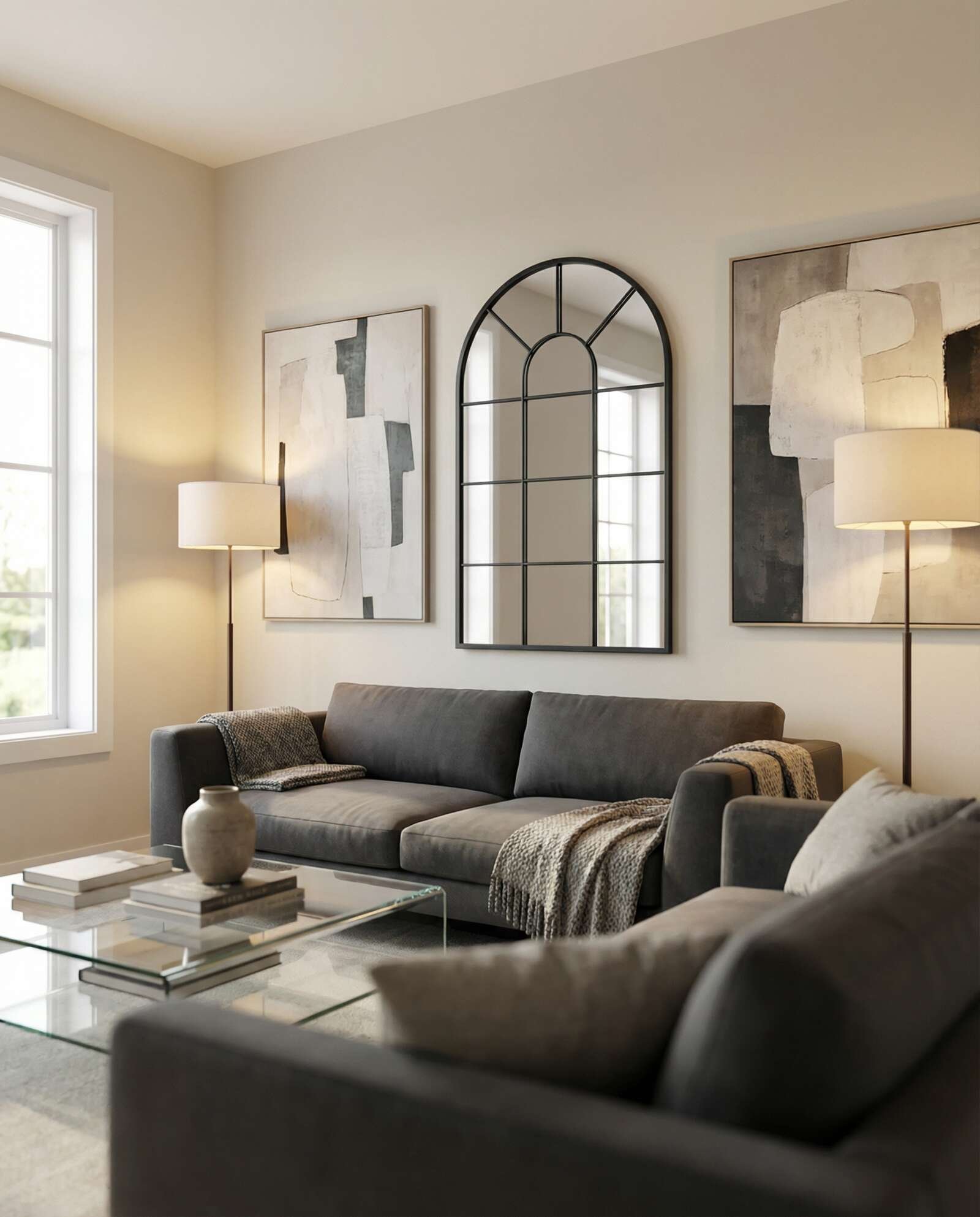
A practical rule of thumb: the centre of your mirror should sit at eye level, roughly 57–60 inches from the floor. If it’s above a sofa, leave 6–8 inches of clearance between the top of the sofa back and the bottom of the mirror frame. Any less and the mirror looks cramped; any more and it floats.
Mirrors positioned opposite a natural light source can increase perceived room brightness by up to 30%, according to interior lighting researchers at the American Society of Interior Designers. For living rooms with north-facing windows or limited daylight, a 48×28″ or 64×30″ arched mirror is one of the most cost-effective lighting upgrades available — no electrician required.
What Size Arched Mirror Works Best for a Living Room Wall?
For a standard living room wall (8–10 feet wide), the 48×28″ or 64×30″ arched mirror is the right choice in the majority of cases. A 2019 survey by Houzz found that 68% of homeowners who felt their living room “lacked personality” identified the walls as the main culprit — and oversized mirrors consistently scored highest for perceived impact per dollar spent. The rule is simple: go one size larger than feels comfortable on paper. Mirrors read smaller on the wall than they look in product photos.
Here’s how to match size to wall width. For walls 5–7 feet wide, the 32×20″ or 48×28″ mirror works beautifully — they create presence without overwhelming. For walls 7–10 feet wide, the 64×30″ is the sweet spot. For large open-plan living rooms with walls over 10 feet, the 70×30″ arched mirror creates a statement-making anchor that draws the entire room together.
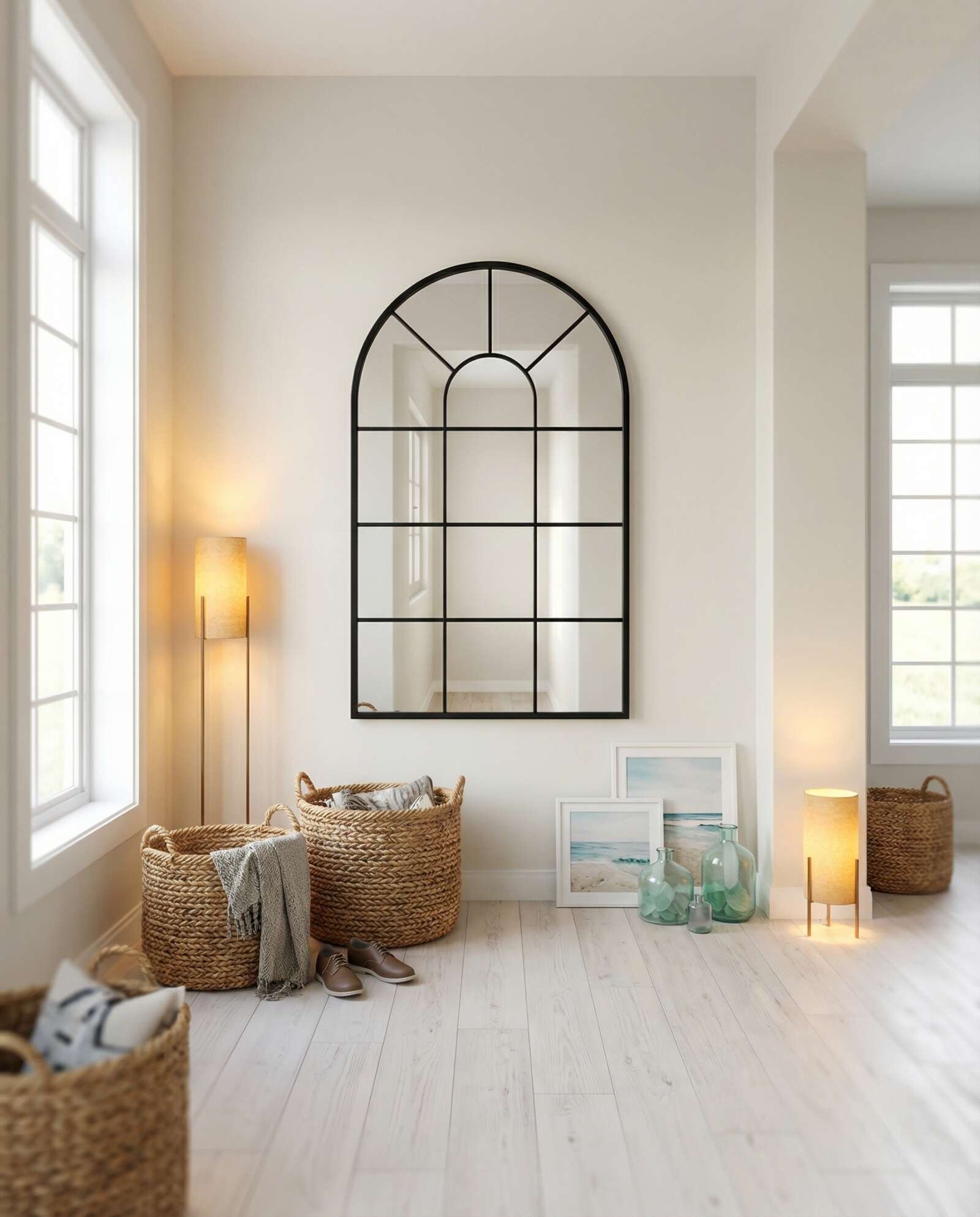
Width matters as much as height. Our arched window pane mirrors have a distinctive multi-pane design — typically 6–8 individual panes within a single black metal arch frame. This gives them visual weight that a plain oval or rectangular mirror of the same dimensions wouldn’t have. You can often go slightly smaller in size and still achieve the same room-filling presence.
A quick test before you buy: cut a piece of kraft paper to the dimensions of the mirror you’re considering and tape it to the wall. Live with it for a day. Nine times out of ten, you’ll go up a size. At Salkala Decor, we’ve found that customers who skip this step and order the smaller size are the ones who come back for an upgrade.
A 2019 Houzz survey found that 68% of homeowners who felt their living room “lacked personality” pointed to blank walls as the primary cause. Mirrors — particularly arched designs with architectural detailing like multi-pane window frames — scored highest for perceived impact per dollar across all wall décor categories. The 48×28″ arched mirror was cited as the most common “confidence purchase” among respondents who said they wished they’d bought sooner.
How Do You Style an Arched Mirror Above a Sofa vs. a Console Table?
Styling an arched mirror above a sofa creates a different effect than placing it above a console table, and understanding the difference helps you choose the right approach for your living room. Above a sofa, the mirror functions as a primary focal point — it needs to be wide enough (at least two-thirds the sofa’s width) to look intentional rather than like an afterthought. Above a console or credenza, the mirror works as part of a layered vignette, and a narrower mirror can shine when paired with flanking objects.
For the above-sofa placement, the 64×30″ or 70×30″ arched mirror is the right starting point for a standard 84–90″ sofa. The proportional relationship between the mirror and the furniture beneath it is everything. A mirror that’s too narrow above a wide sofa looks like a forgotten afterthought. One that’s the right width creates a room that looks deliberately, confidently designed.
For the console table placement, you have more flexibility. A 48×28″ or even a 32×20″ mirror can work beautifully when styled with flanking table lamps, a small plant or sculptural object, and a tray or stack of books on the table itself. The key is layering: the mirror becomes the tallest element, the lamps sit at mid-height, and the smaller objects ground the base. This creates visual rhythm that makes the whole arrangement feel curated.
Interior design research from the Design Institute of Australia suggests that mirrors hung above furniture pieces work best when they span at least 60–70% of the furniture’s width below them. For a standard 84″ sofa, that means a minimum mirror width of 50″, making the 64×30″ Arched Window Pane Mirror (available at salkaladecor.store) the ideal choice for that placement.
One styling detail that works especially well with arched mirrors in living rooms: lean, don’t hang. Leaning a 64×30″ or 70×30″ mirror against the wall behind a console creates a relaxed, layered look that feels current and lived-in. It’s also forgiving if you’re renting or haven’t found your permanent placement yet. The black metal frame holds its own whether hung formally or leaned casually.
> Our observation: At Salkala Decor, we’ve noticed that customers with open-plan living/dining areas consistently choose the 70×30″ mirror leaned behind a console table as their favourite configuration. The height of that mirror — nearly 6 feet — anchors the living zone visually when there are no walls to define the space otherwise.
Shop the Look: Arched Window Pane Mirrors for Every Living Room
At Salkala Decor, we make one thing: the Arched Window Pane Mirror (AWPM) in black metal. We make it in four sizes because living rooms aren’t one-size-fits-all. Each mirror features the same distinctive multi-pane arch design, the same matte black powder-coated frame, and the same quality glass — just scaled to suit your specific wall.
- 32×20″ Arched Window Pane Mirror — Perfect for accent walls, powder rooms, and smaller living room spaces. Pairs beautifully with a narrow console table or floating shelf.
- 48×28″ Arched Window Pane Mirror — The most versatile size in our range. Works above a 60–72″ console, flanking a fireplace, or as a standalone statement piece on a feature wall.
- 64×30″ Arched Window Pane Mirror — The designer’s pick for above-sofa placement in standard living rooms. At nearly 5½ feet tall, it commands a wall without crowding it.
- 70×30″ Arched Window Pane Mirror — For large living rooms, open-plan spaces, or anyone who wants their mirror to be the undeniable centrepiece. Nearly 6 feet tall, stunning leaned or hung.
All four sizes are available at salkaladecor.store with free shipping, or through our Amazon USA storefront for Prime-eligible delivery. We also carry the full range on Etsy for customers who prefer that platform.
Not sure which size is right for your wall? Measure your wall width, multiply by 0.65, and that’s the minimum mirror width that will look proportional. Then go one size up from whatever that number suggests. You won’t regret it.
Frequently Asked Questions About Arched Mirrors in Living Rooms
How high should I hang an arched mirror in my living room?
The centre of your mirror should sit at approximately 57–60 inches from the floor — roughly eye level for a standing adult. If you’re hanging the mirror above a sofa, leave 6–8 inches between the top of the sofa cushions and the bottom of the frame. Studies in human-centred design suggest this gap prevents the mirror from looking as though it’s “resting” on the furniture beneath it, which can make a room feel low and heavy.
Can I use an arched mirror in a small living room?
Absolutely — in fact, small living rooms benefit more from a well-placed mirror than large ones do. Research from the Colour and Space Lab at the University of Leeds found that vertical mirrors increase perceived ceiling height, while wide mirrors increase perceived room width. Our 32×20″ arched mirror is specifically designed for spaces where a larger mirror would feel overwhelming but a small round mirror would feel timid.
Should a living room mirror match the furniture style?
It doesn’t have to, and in many cases it shouldn’t. The arched window pane mirror’s black metal frame works as a grounding contrast element across furniture styles — it reads as architectural rather than decorative. Interior styling surveys consistently show that mixing one “graphic” black metal element into a warm-toned or neutral living room creates the kind of visual tension that makes a room feel intentionally designed rather than accidentally assembled.
How do I stop a mirror from making a room look too busy?
The key is controlling what the mirror reflects. Before hanging, stand in the intended spot and hold up a mirror to see the reflection. If it shows a cluttered shelf, an ugly ceiling fixture, or a blank wall, reposition. A mirror that reflects a window, a lamp, or greenery adds visual richness without busyness. At Salkala Decor, the customers happiest with their mirror placements are the ones who spent five minutes with a hand mirror before drilling a single hole.
Is it okay to lean a large mirror against the wall instead of hanging it?
Yes, and it’s one of the most popular styling choices for our larger mirrors. Leaning a 70×30″ arched mirror behind a console table or sideboard creates a relaxed, layered aesthetic that’s very much aligned with how contemporary interiors are styled in 2026. Ensure the mirror is leaning against a wall stud or has an anti-tip strap for safety — the 70×30″ weighs approximately 28 lbs and should be secured even when leaned.
The Right Mirror Changes Everything
The living room is the room people spend the most time in and the room they show to guests first. It deserves to be finished. Not just furnished — finished. An arched mirror with a black metal frame doesn’t just reflect light; it reflects a point of view. It tells the room (and everyone in it) that this space was considered, not assembled.
You now have the placement rules, the sizing logic, and the styling know-how to make that happen. The only thing left is choosing your size. Browse the full Salkala Decor mirror collection, find your wall measurement, and let the light do the rest. Or shop directly on Amazon USA for Prime delivery.
Luxury meets reflection — and it starts with one great mirror on the right wall.
Salkala Decor — Luxury Meets Reflection. Shop our arched mirror collection at salkaladecor.store or Amazon USA.