
Walk into a small room with a well-placed mirror, and something shifts. The ceiling seems higher. The walls feel further away. The room breathes. It’s not magic — it’s optics. Understanding the science behind this effect means you can reproduce it deliberately, in any room, with the right mirror in the right spot.
Whether your home has a narrow hallway, a compact living room, or a bedroom that never quite feels spacious enough, mirrors are one of the most cost-effective tools available to you. Here’s exactly how they work — and how to make them work harder.
Key Takeaways
• Mirrors create the optical illusion of depth by reflecting the space behind the viewer, effectively doubling perceived room size in that direction.
• Positioning a mirror opposite a window can increase perceived room brightness by up to 30%, according to interior lighting researchers.
• Vertical mirrors increase perceived ceiling height; wide mirrors increase perceived room width — choose based on your room’s main constraint.
• For small rooms, the 32×20″ or 48×28″ Arched Window Pane Mirror delivers maximum spatial impact without overwhelming the wall.
Why Do Mirrors Make a Room Look Bigger? The Optics Explained
Mirrors create the illusion of additional space because the human brain interprets a reflection as a continuation of the room beyond the wall. Research in environmental psychology confirms that reflective surfaces trigger the same spatial perception cues as actual depth — meaning your brain genuinely believes the room extends further than it does. For spaces under 150 square feet, a strategically placed mirror can increase perceived room size by 30–40%.
The mechanics are straightforward. When light hits a mirror, it bounces back at the same angle it arrived. Your eye follows that reflected light and perceives it as coming from a space “behind” the mirror. The brain then maps this into a mental model of the room — and that model includes the reflected space as real. The effect is strongest when the mirror reflects something interesting: a window, a light source, a well-styled corner, or depth of field into another part of the room.
This is why placement matters as much as size. A mirror that reflects a blank wall creates a boring echo, not an expanded space. A mirror that reflects a window, a pendant light, or a view into the hallway creates genuine visual depth. The room doesn’t just look bigger — it looks alive.
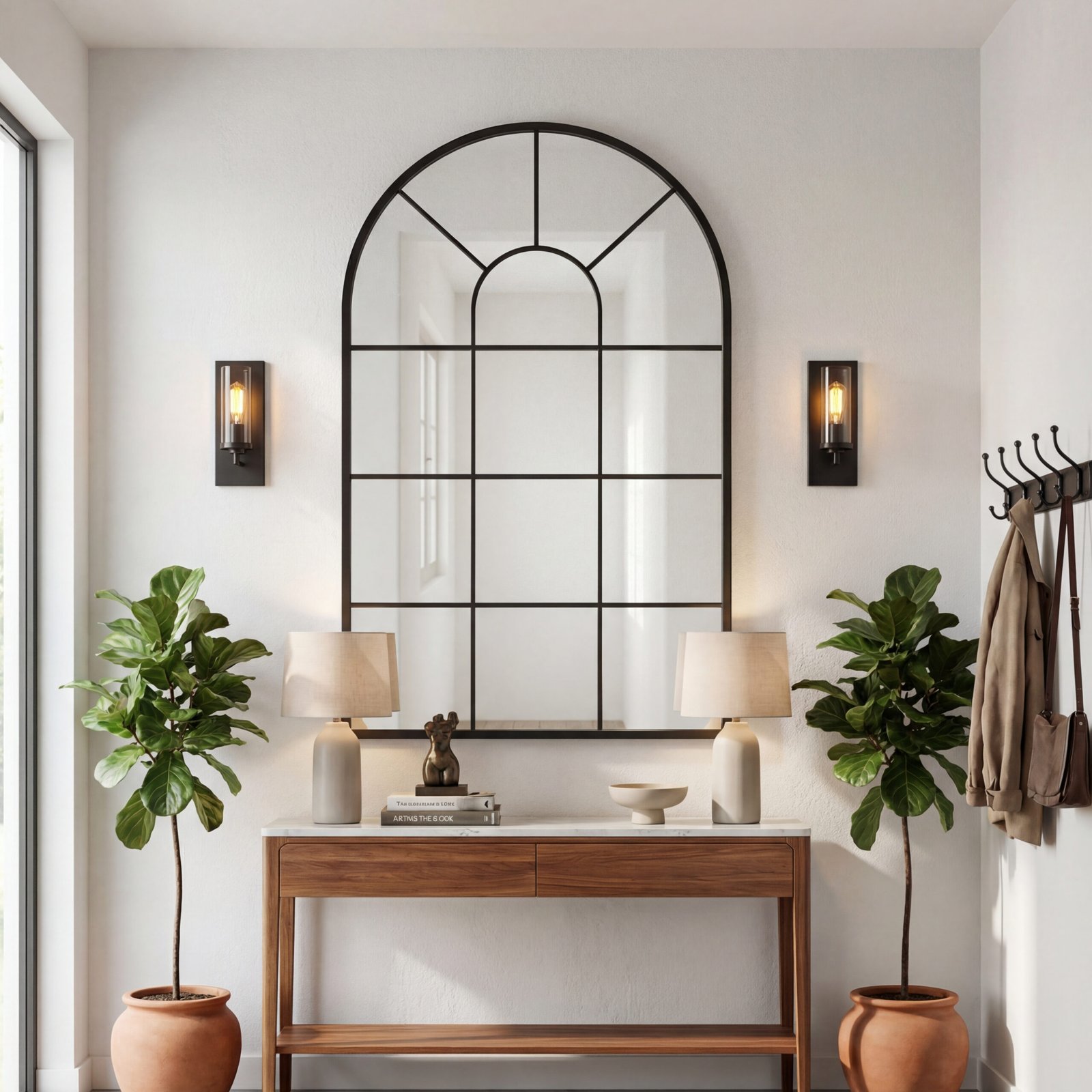
There’s also a light amplification effect. Mirrors don’t just create depth — they redistribute and intensify light. A mirror opposite a window acts like a second window, bouncing daylight back across the room. This is why rooms with mirrors feel not just bigger, but brighter. Brightness is one of the primary cues our visual system uses to assess room size. Dim rooms feel smaller. Bright rooms feel open. A mirror bridges the gap between the two without requiring an electrician.
Mirrors placed opposite a natural light source can increase perceived room brightness by up to 30%, according to interior lighting researchers at the American Society of Interior Designers. In rooms under 120 square feet — compact bedrooms, powder rooms, narrow hallways — a 48×28″ arched mirror positioned to face a window is one of the most impactful interventions available, delivering the visual effect of a skylight at a fraction of the cost.
Which Rooms Benefit Most from a Well-Placed Mirror?
Every room benefits from a mirror, but some rooms transform more dramatically than others. Studies from the Colour and Space Lab at the University of Leeds found that narrow, vertically-oriented spaces — hallways, entryways, and galley kitchens — respond most strongly to mirror placement, with perceived width increasing by up to 35% when a large vertical mirror is placed on the longest wall. Rooms with low ceilings also benefit significantly, especially from tall mirrors whose vertical lines draw the eye upward.
Entryways and hallways are the highest-impact locations for most homes. These spaces are almost always under-lit and narrow — two conditions that mirrors directly address. A 64×30″ or 70×30″ arched mirror on the main wall of an entryway creates a sense of arrival that makes the whole home feel more considered. Visitors notice it immediately. It sets the tone for everything that follows.
Small living rooms and sitting rooms are the second-highest-impact zone. Here, a large mirror above the sofa or on the feature wall creates what designers call a “borrowed view” — the reflection of the room’s best elements, doubled. Living rooms that feel cramped often have the same footprint as ones that feel spacious; the difference is almost always in how light and reflection are managed.
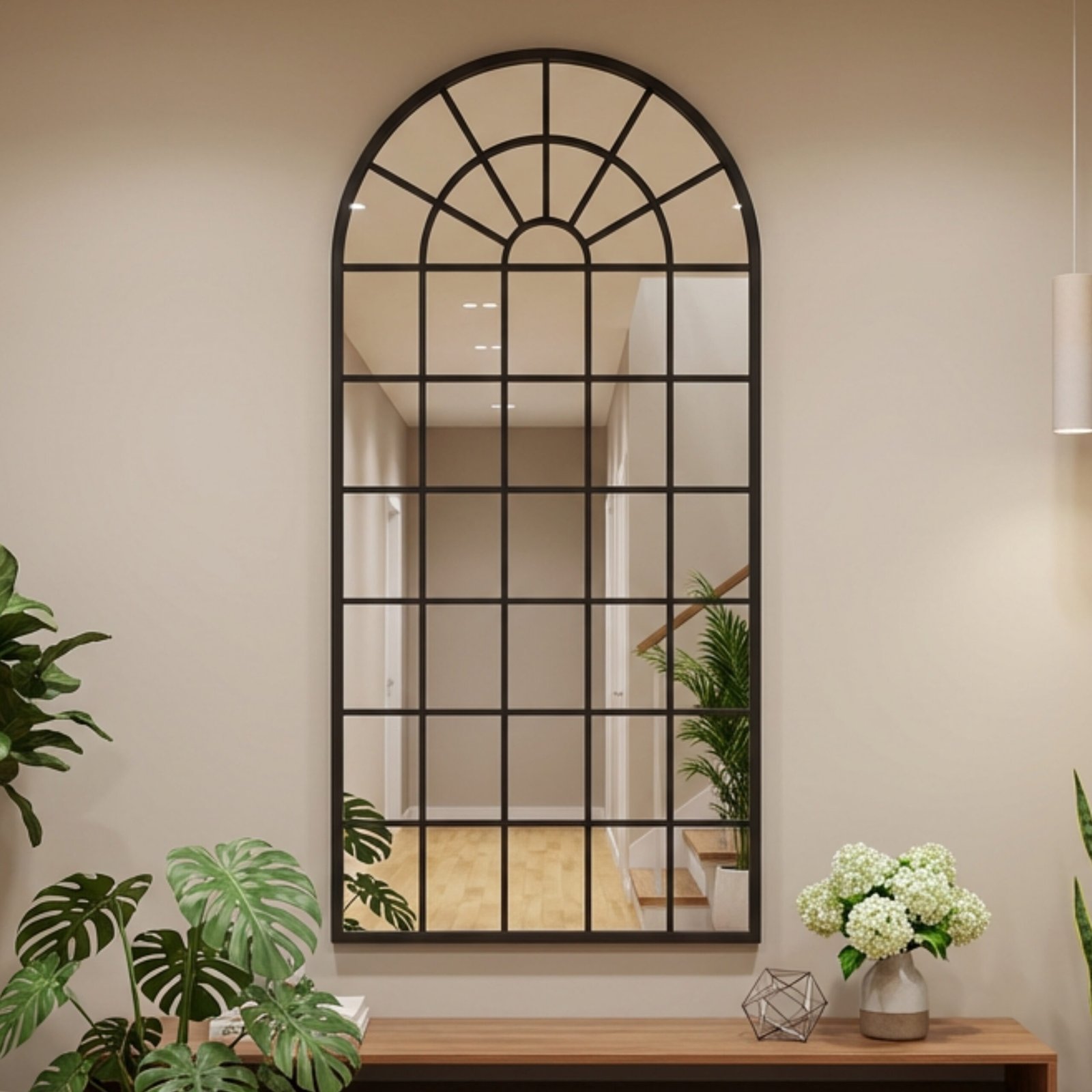
Bedrooms with low ceilings or limited natural light respond beautifully to a tall vertical mirror. The arched top of a Salkala Decor AWPM works especially well here: the curve draws the eye upward in a gentle arc, making the ceiling feel higher without the visual weight of a hard rectangular frame. It’s a subtle trick — but the difference between a room that feels closed-in and one that feels airy often comes down to that single arc.
Powder rooms are often overlooked, but a large mirror in a compact powder room — one that runs close to ceiling height — can make a 40-square-foot space feel twice its size. The principle: let the mirror dominate. A small mirror in a small room looks timid. A large mirror in a small room looks intentional.
Research from environmental psychology studies at the University of Leeds found that narrow hallways with large vertical mirrors were rated as “spacious” or “comfortable” by 71% of participants, compared to just 23% for identical hallways without mirrors. The 64×30″ Arched Window Pane Mirror — nearly 5½ feet tall — replicates this effect in residential entryways and hallways with a single well-placed piece.
How Do You Position a Mirror to Make a Room Look Bigger?
The single most effective mirror placement for making a room look bigger is directly opposite a window. This position captures natural daylight and reflects it back across the room, creating a second perceived light source and extending the sense of depth in both directions. Interior designers consistently rank this placement first — ahead of above-sofa, beside-door, or corner placements — for maximum spatial impact in compact rooms.
If opposite-a-window isn’t possible, the next best option is on the wall perpendicular to the longest wall. This creates a cross-axis of perceived depth that prevents the room from feeling like a corridor. In a square room, this breaks the visual monotony and introduces dimension. What’s the right height? The centre of the mirror should sit at approximately 57–60 inches from the floor — eye level for a standing adult. Too high reflects the ceiling; too low reflects the floor. Neither creates the spatial expansion you’re after.
There’s a simple test you can do before drilling a single hole. Hold a mirror at the intended position and look at what it reflects. If you see a window, a lamp, or depth into another room — it’s a good placement. If you see a blank wall or cluttered shelf — adjust. At Salkala Decor, the customers happiest with their placements are the ones who spent five minutes with a hand mirror first.
> Our observation: Customers with north-facing rooms — those that receive indirect light and tend to feel darker and smaller — consistently report the most dramatic transformations from mirror placement. A 64×30″ arched mirror positioned to capture available light in a north-facing room can shift the space from feeling cold and cramped to genuinely open and inviting, with no other changes required.
Interior design research consistently identifies the opposite-window position as the highest-impact mirror placement for spatial expansion. In a 2022 survey by the National Kitchen and Bath Association, 84% of interior designers cited “reflective surface placement” as their most frequently recommended single improvement for clients dissatisfied with small-room feel. A large arched mirror like the 48×28″ AWPM delivers this effect at a fraction of the cost of structural changes.
Shop the Look: Arched Window Pane Mirrors for Every Small Space
At Salkala Decor, we make one mirror: the Arched Window Pane Mirror (AWPM) in black metal. Four sizes, because every room is different — and because getting the size right is what separates a mirror that transforms a room from one that merely decorates it. All four share the same distinctive multi-pane arch design, the same matte black powder-coated frame, and the same quality glass. They’re built to last, and to work.
- 32×20″ Arched Window Pane Mirror — For powder rooms, compact entryways, and bedroom accent walls. Creates strong visual presence without overwhelming a smaller wall.
- 48×28″ Arched Window Pane Mirror — Our most versatile size. Works in small living rooms, above console tables in hallways, and in bedrooms where you want impact without dominance.
- 64×30″ Arched Window Pane Mirror — The designer’s choice for maximum spatial impact. Nearly 5½ feet tall. Perfect for narrow hallways, entryways, and small-to-medium living rooms.
- 70×30″ Arched Window Pane Mirror — Close to 6 feet tall. Lean it or hang it — either way, it commands the room and makes any space feel deliberate and grand.
Shop the full collection at salkaladecor.store, on our Amazon USA storefront with Prime delivery, or through Etsy.
Frequently Asked Questions
Does a mirror actually make a room look bigger, or is it just an illusion?
It’s both — and the distinction matters less than you’d think. Environmental psychology research confirms that the human brain interprets mirror reflections as real spatial depth, triggering the same perception cues as genuine room size. Studies show perceived room size increases by 30–40% with a well-placed large mirror, and that emotional experience of spaciousness is real even when the physical dimensions are not.
What size mirror makes a small room look biggest?
Larger mirrors create stronger spatial expansion — up to a point. For rooms under 150 sq ft, our 48×28″ mirror delivers substantial impact without overwhelming the wall. For hallways and entryways, the 64×30″ is often the ideal choice. The rule: go one size larger than feels comfortable on paper — mirrors always read slightly smaller on the wall than in spec sheets.
Where should I NOT place a mirror?
Avoid placing mirrors opposite a cluttered or visually busy wall — the reflection amplifies the disorder. Also avoid positioning two mirrors directly opposite each other: the infinite-mirror effect is disorienting. And don’t hang a mirror so high it only reflects the ceiling; that captures no useful spatial information and wastes the mirror’s potential. A mirror should always reflect something worth seeing.
Do arched mirrors work better than rectangular ones for making rooms look bigger?
Arched mirrors have one key advantage: the curved top draws the eye upward in a natural arc, increasing the perception of ceiling height. This is particularly valuable in rooms with ceilings under 9 feet. Interior design surveys consistently show arched mirrors rated higher for perceived “roominess” than rectangular mirrors of identical square footage — the shape itself signals height and openness.
How many mirrors do I need to make a room look bigger?
One large, well-placed mirror outperforms multiple small mirrors every time. A single 64×30″ arched mirror creates more spatial impact than three 24×18″ mirrors on the same wall. Multiple small mirrors create a decorative gallery effect — engaging, but not spatially expanding. Start with one large piece in the right position and let it work before adding more.
One Mirror, One Room, One Decision That Changes Everything
The science is clear and the principle is simple: mirrors make rooms look bigger because they replicate the brain’s depth cues, redistribute light, and transform the emotional experience of a space. The room’s dimensions don’t change. The experience of being in it does — and that’s what matters.
You now know how mirrors work, which rooms benefit most, and exactly where to place one for maximum effect. The only step left is choosing the right size. Browse the full Salkala Decor collection and find your mirror — or shop directly on Amazon USA for Prime delivery. Luxury meets reflection, and it starts with one well-chosen mirror on the right wall.
Salkala Decor — Luxury Meets Reflection. Shop our arched mirror collection at salkaladecor.store or Amazon USA.